
Introduction
Perched atop a narrow mountain ridge, surrounded by sheer drop-offs and shrouded in the mist of the Andean forest, lies Sayacmarca—one of the most impressive and enigmatic archaeological sites along the Inca Trail to Machu Picchu.
Unlike the famous citadel of Machu Picchu, Sayacmarca remains a relatively little-known site, visited only by those trekking the Classic Inca Trail. Yet, its strategic location, extraordinary architecture, and the mysteries still surrounding its history make it one of the Inca Empire’s most fascinating archaeological gems.
Built on a mountain that is difficult to access, Sayacmarca demonstrates the Incas’ remarkable mastery of engineering, urban planning, and adaptation to the natural environment.
In this blog post, you will discover the history of Sayacmarca, its significance along the Inca Trail, and why it is considered one of the most astonishing fortresses in the Andes.
Where Is Sayacmarca Located?

Sayacmarca is located within the Machu Picchu Historic Sanctuary, at an altitude of approximately 3,600 meters above sea level, in one of the most spectacular sections of the Inca Trail.
The complex stands atop a narrow rock formation, surrounded by mountains, cloud forests, and deep valleys.
From its terraces, one can enjoy breathtaking views of:
- The Vilcabamba mountain range.
- The Andean forests.
- The ancient paths of the Inca Trail.
- The valleys surrounding the citadel.
Its location would have allowed for visual monitoring of a significant portion of the ancient Inca road network.
What Does Sayacmarca Mean?
The name Sayacmarca comes from the Quechua language.
It is generally interpreted as:
- “Inaccessible Town.”
- “Dominant City.”
- “Hard-to-Reach Place.”
These interpretations perfectly reflect the site’s characteristics.
The town was built on a mountain that is difficult to access, naturally protected by steep slopes and narrow paths.
This design provided excellent defense and allowed for the monitoring of travelers traversing the Inca Trail.
The History of Sayacmarca
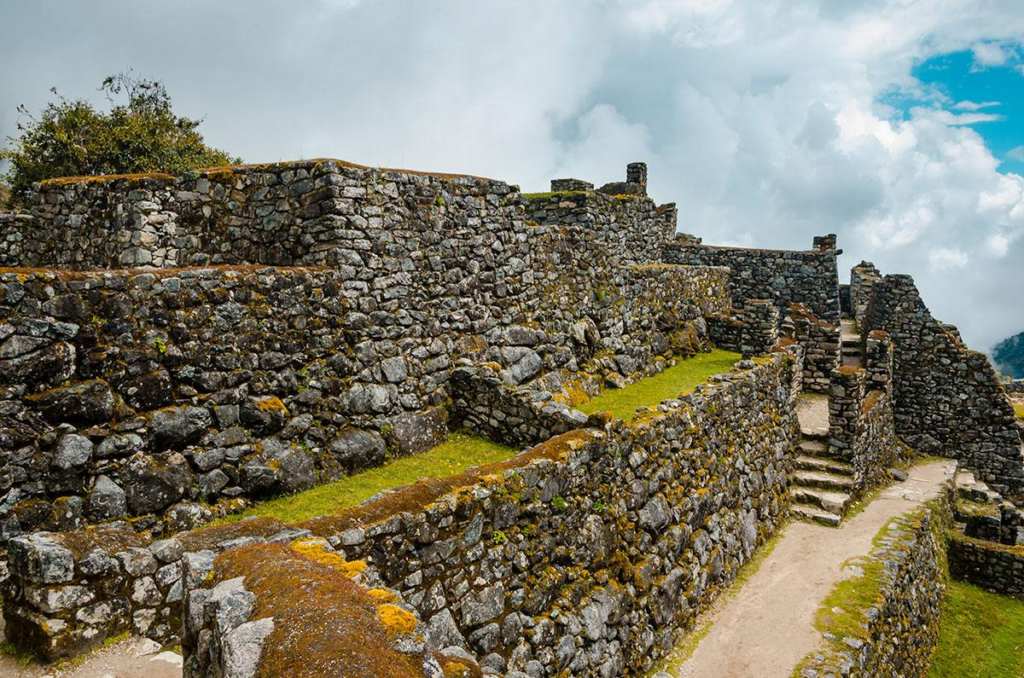
Although many aspects of its origin remain unknown, archaeologists believe Sayacmarca was built during the expansion of the Inca Empire—possibly under the rule of Inca Pachacuti—in the 15th century.
Its exact function is still being studied, but most research agrees that it served several important roles:
- Administrative center.
- Inca Trail checkpoint.
- Ceremonial site.
- Agricultural center.
- Rest stop for travelers and officials.
Its strategic location allowed for the monitoring of the movement of people and goods along this important route.
A Natural Fortress
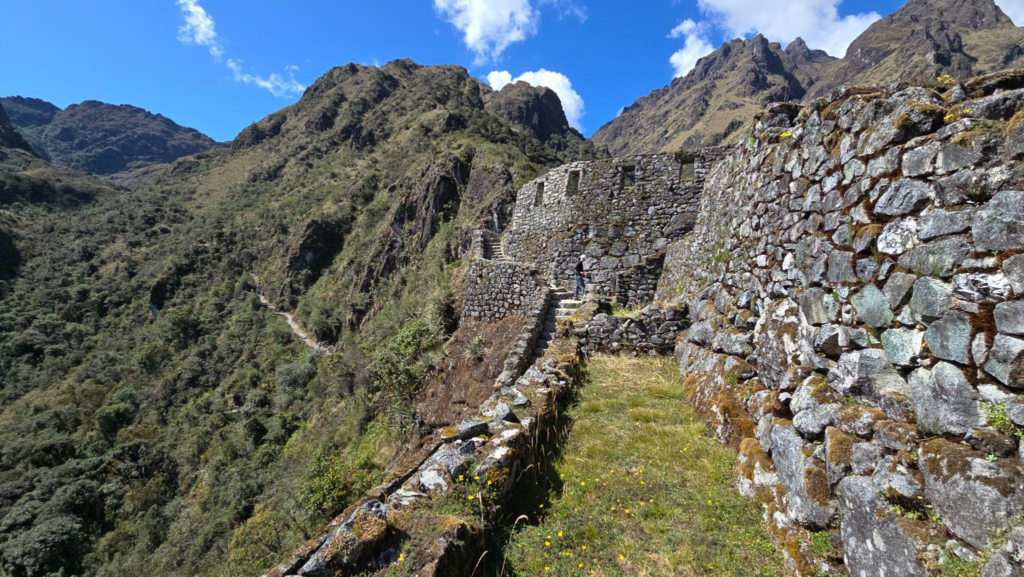
One of the most striking features of Sayacmarca is that it resembles a natural fortress.
The city was built by fully utilizing the mountain’s geography.
Accessing the complex requires traversing:
- Stone stairways.
- Narrow paths.
- Passages flanked by precipices.
This layout made the site easy to defend and difficult to conquer.
Although there is no definitive evidence that it served exclusively as a military fortress, its design demonstrates that the Incas made the most of the terrain’s natural advantages.
The Architecture of Sayacmarca
The architecture of Sayacmarca represents one of the finest examples of Inca engineering.
The complex consists of:
- Dwellings.
- Plazas.
- Stairways.
- Water channels.
- Agricultural terraces.
- Carefully carved stone walls.
As with other Inca sites, the stones were fitted together with great precision, without the use of mortar.
Many structures remain stable after more than five centuries.
The Hydraulic System
Inca engineers also developed an efficient hydraulic system at Sayacmarca.
The complex features:
- Stone channels.
- Fountains.
- Drainage systems.
- Water runoff systems.
These structures supplied water to the inhabitants and protected the buildings from the heavy rainfall of the cloud forest.
The integration of architecture and engineering demonstrates the high level of technology achieved by the Inca Empire.
The Agricultural Terraces
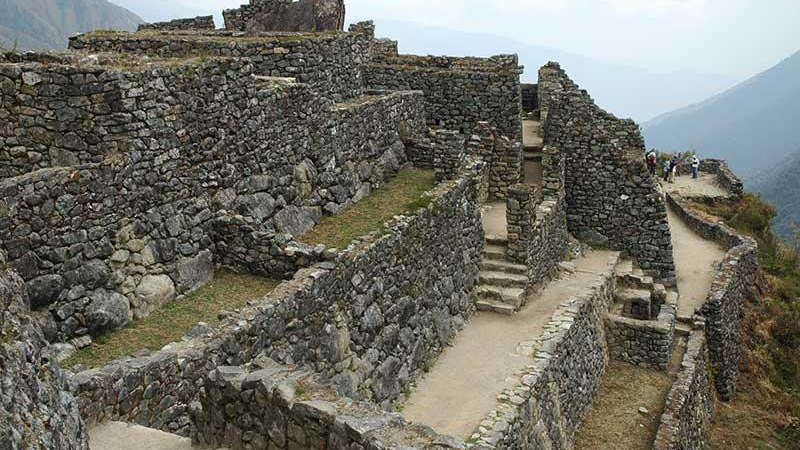
Agricultural terraces served multiple functions.
In addition to enabling food cultivation, they helped to:
- Prevent erosion.
- Stabilize the mountainside.
- Drain rainwater.
- Expand arable land.
This agricultural system was a cornerstone of the Inca Empire’s economic development.
Sayacmarca and the Inca Trail
Sayacmarca occupied a strategic position along the Qhapaq Ñan, the Inca Empire’s vast road network.
From this vantage point, it was possible to control a significant portion of the traffic between Cusco and the Machu Picchu region.
Today, hikers on the Inca Trail pass through Sayacmarca on the second day of the trek, after completing some of the route’s most challenging sections.
For many travelers, this site is one of the most impressive highlights of the entire expedition.
The Natural Surroundings of Sayacmarca

The complex is surrounded by the cloud forest of the Machu Picchu Historic Sanctuary.
This area is home to extraordinary biodiversity.
Notable species include:
Flora
- Orchids.
- Ferns.
- Bromeliads.
- Mosses.
- Lichen-covered trees.
Fauna
- Hummingbirds.
- Andean Cock-of-the-rock.
- Tanagers.
- Butterflies.
- Spectacled bear (occasionally).
The combination of nature and archaeology makes Sayacmarca one of the most photogenic landscapes on the Inca Trail.
Interesting facts about Sayacmarca
1. Its name is often translated as “Inaccessible Town” or “Dominant City.”
2. It is located approximately 3,600 meters above sea level.
3. It was built on a narrow mountain ridge.
4. Access is provided by long stone stairways.
5. It preserves water channels and agricultural terraces in excellent condition.
6. It is part of the Machu Picchu Historic Sanctuary.
7. It can only be visited by hiking the authorized Inca Trail.
8. It is one of the best-preserved archaeological sites along the route.
Frequently Asked Questions
What does Sayacmarca mean?
It is generally interpreted as “Inaccessible Town” or “Dominant City,” due to its location on a mountain that is difficult to access.
Where is it located?
Within the Machu Picchu Historic Sanctuary, approximately 3,600 meters above sea level, on the Inca Trail.
What was its function?
It is believed to have been an administrative, ceremonial, and control center for the Inca Trail, featuring agricultural and residential areas as well.
Can it be visited without hiking the Inca Trail?
No. Currently, access to Sayacmarca is reserved for those hiking the Inca Trail with official authorization.
What makes Sayacmarca special?
Its strategic location, the quality of its architecture, its advanced hydraulic system, and the stunning views of the cloud forest make it one of the most fascinating archaeological complexes on the Inca Trail.
Conclusion
Sayacmarca is one of those places that demonstrate that the legacy of the Inca Empire extends far beyond Machu Picchu. Built atop a mountain that is difficult to access, this ancient city reflects the extraordinary knowledge the Incas possessed regarding architecture, engineering, urban planning, and adaptation to the natural environment.
Its terraces, stairways, water channels, and stone structures continue to withstand the passage of time, while the cloud forest and mist create a setting that seems frozen in history.
For those traversing the Inca Trail, visiting Sayacmarca means discovering a city hidden among the mountains, where every path and every wall tells part of the story of one of the Americas’ most extraordinary civilizations.